Multi-Tiered Systems of Support (MTSS)
Welcome to MTSS in Montana
MTSS is a framework for school improvement that focuses on system level change across the classroom, school, and district to provide all students with the best opportunities to maximize achievement, both academically and behaviorally. MTSS focuses on providing high quality instruction and interventions matched to student need, monitoring progress frequently to make decisions about changes in instruction or goals, and continually checking fidelity of interventions. Data is used to allocate resources to improve student learning and support staff implementation of effective practices.
MTSS is a systemic approach:
- Tier l: Core Instruction - All students will be part of strong initial instruction.
- Tier ll: Targeted Intervention - Even with strong initial instruction, some students will need targeted support to be successful.
- Tier lll: Intensive Intervention - Even with strong initial instruction, and targeted support, a few students will need intensive support to be successful.
Why MTSS?
MTSS is a framework for school improvement that focuses on system level change across the classroom, school, and district to provide all students with the best opportunities to maximize achievement, both academically and behaviorally. MTSS focuses on providing high quality instruction and interventions matched to student need, monitoring progress frequently to make decisions about changes in instruction or goals, and continually checking fidelity of interventions. Data is used to allocate resources to improve student learning and support staff implementation of effective practices.
MTSS Essential Components
Team-Based Leadership
A team approach helps to distribute the workload among multiple individuals and facilitates collaboration and communication. Teams (district, building, and educator) that collaborate and communicate contribute to the alignment and cohesion of leadership teams allows for a systematic approach to data-based problem solving and keep the focus on improved outcomes for all students.
Consensus & Commitment
Building consensus creates the good-will and buy-in that reflects a mutual understanding and agreement to support the actions and responsibilities involved with the implementation of MTSS. Successful implementation, durability, and scaling up of MTSS is dependent on the commitment of all stakeholders to allocate sufficient time and resources.
Evidence-Based Instruction, Interventions and Support
Using Evidence-Based Practices (EBPs) with fidelity leads to an increase in the likelihood of positive student outcomes and responsiveness to learner's needs, and to a decrease in wasted time and resources because educators start with an effective practice or program and are not forced to find one through trial and error.
Collaborative Teams
Collaborative teams (grade level, departmental, Tier 1, Tier2, Tier 3) work interdependently to learn about and communicate the impact of instruction using evidence of student progress to improve outcomes for all students. Collaboration occurs within a framework that increases focus through a standard agenda and problem-solving process.
Tiered Delivery System
The framework of a multi-tiered approach provides for efficient and effective allocation of resources. When appropriately used, the tiers support each learner to experience success by meeting their unique needs. Salient to this preventative approach are universal screening, a high quality core instruction, progress monitoring, increasingly intensive tiers intervention, and fidelity of implementation.
Comprehensive Screening & Assessment
A comprehensive screening and assessment system contributes to an outcomes-driven approach that includes meaningful evaluation and commitment to continuous improvement. The data are used to guide determine which practices, interventions, and system change strategies are needed to improve student achievement.
Data-based Decision Making
Using a Data Based Decision Making process shifts the work of school leadership teams from a reactive or crisis driven process to a pro-active, outcomes driven process, and sets the stage for continuous improvement. Data analysis allows for evidence to guide decision making for both the effectiveness of the system and for the needs of all learners. Examination of data using a standard problem-solving process to provide information to narrow the problem to identify potential interventions and strategies.
The benefits of Multi-tiered Systems of Support include quality instruction, a team approach for identifying individual student needs, providing evidence-based tiered interventions, and data-driven procedures for monitoring student progress. The framework is comprehensive, efficient, and effective. The MTSS problem-solving approach addresses academics, behavior, attendance, and social needs -- improving learning outcomes for EVERY student.
Benefits to Schools in Montana
Leadership and tiered teams implement a systematic approach to MTSS implementation. Key decision makers look at the effects of implementation and adjust the systems, data, and practices for academics and behavior as needed for the success of all students.
MTSS has provided a framework to guide our data driven decision making process at Anderson School. Our leadership team reviews behavior and academic data on a consistent basis and this has been instrumental in prioritizing adjustments to our systems and practices. Student success has been greatly enhanced with the implementation of our MTSS process.
Heidi Fasting, Student Coordinator/ MTSS Facilitator, Anderson School in Bozeman, MT
Universal school-wide positive behavior expectations and supports, culturally and linguistically responsive practices, and social emotional learning are ongoing throughout the school year to help create a safe and positive learning environment for all.
One of the most important things for every school is consistency and clarity of expectations. This can be a difficult process. MTSS was the framework we used to achieve consensus within our staff and to positively reinforce what we expect of our students.
Jeff Friesen, Principal, Lewistown Junior High School in Lewistown, MT
Teachers and school staff benefit from MTSS professional development related to screening, progress monitoring, and research/evidence-based instruction and interventions, leading to better preparation for teaching all of their students and resulting in improved student outcomes.
“Utilizing MTSS professional development for screening and progress monitoring has enabled our staff to consistently implement data-driven decisions, thus resulting in improved student outcomes. All of our teachers use the same process with fidelity so we know all students are treated fairly and given equal opportunities to succeed.”
Jill Gliko, K-12 Counselor, Belt School
Data-based decision making is ongoing throughout the school year and leads to early intervention and continuous improvement for all students.
Using MTSS has enabled us to support our Tier 2 and Tier 3 children with data. When our team developed specific goals and objectives for each child and they were implemented and reviewed on a bi-weekly or monthly basis gains were made. We were looking forward to our end of the year data, and Covid 19 happened.
Kootenai Valley Head Start, Libby, MT
Researched-based instruction, universal screening, progress monitoring, and quality instruction and interventions are in place. As soon as student need arises for tiered support or enrichment, the correct practices are put into place, leading to student success at an accelerated rate.
MTSS has given us a framework to work from to ensure our school improvement process is moving forward each year. With our MTSS systems in place and going into the school closure this past year, we were able to connect with all students more effectively and we had more in depth knowledge on how to support our students with the highest needs.
Tim Majerus, Principal, Fergus High School in Lewistown, MT
The MTSS framework of supportive systems, continuous data review, and application of evidence based practices supports engaged communication between families, school staff, and the community for the benefit of all students.
It's hard to argue the benefits the MTSS model has provided for our students, staff, school system, and parents, and it's been rewarding watching this transformation take place over the years. The process of implementing MTSS and the professional development that came with it not only grew our understanding and the importance of collecting and using data to guide decision making, but increased our understanding of the importance of using research-based instruction and interventions with fidelity as well. The process also led to increased communication and collaboration amongst staff and between the school and families. In addition, implementing MTSS has led to more consistency within the school system despite the occasional turnover of staff, and has helped better meet the individual academic, behavioral, and social emotional needs of our students. Finally, implementing MTSS has helped develop our teacher leaders as well as helped continue to grow our team based approach and positive school culture.
Brian Hilton, Principal, Ennis Elementary in Ennis, MT
How do we get started? This is one of the first questions about MTSS.
Some of the answers to this question might include:
- What is your mission/vision statement? Discuss with your team how Multi-Tiered Systems of Support might support those core beliefs and goals.
- Do you need a team? Discuss this with your administrator and put together a team, representative of your school, who want to create a multi-tiered system of supports. It is vital to have your administration on board for essential support and leadership.
- Use your school data as the basis for discussing why your school needs MTSS. This may include academics, social/behavioral, attendance, climate, and staff, student, and parent surveys.
- Access the MTSS Overview Video for your staff.
- Or you could put together a District MTSS Training Plan or a School MTSS Training Plan that includes:
- expanding your District and/or Building Teams' knowledge of Multi-Tiered System of Supports and the purpose of the MTSS systems framework
- the importance of data-driven decision making
- how to identify school-wide, grade level and individual student needs
- setting up evidence-based interventions
- an ongoing monitoring/review process to view outcomes
- a comprehensive problem-solving approach that addresses academic, behavior, attendance, and social-emotional needs -- improving learning outcomes for EVERY student!
- District Implementation Team (DIT) Modules
- Building Implementation Team (BIT) Modules
Essential Components
The MTSS Essential Components identify the core components of the Multi-Tiered Systems of Support framework and describes the key activities that are associated with each core component. Clearly defined components and practices are a pre‐requisite for sound implementation. The Montana MTSS Essential Components are designed to help identify standards or expectations for what MTSS looks like in practice within schools.
The Tier 1, Tier 2, and Tier 3 Practice Profiles for each tier in the Multi-Tiered Systems of Support are organized by systems, data, and practices. They address the essential components of a comprehensive framework of MTSS designed to meet the individual needs and assets of the whole child (cognitive, behavioral, physical, social and emotional). The MTSS Essential Components are written using language to support both academic and non-academic content areas (e.g., literacy, mathematics, behavior, mental health). The Essential Components are based on, and incorporate, guidelines developed by the National Center for Intensive Intervention.
Read through the information below to start learning about the MTSS Essential Components that make up the MTSS practice.
What does it mean?
A representative Leadership Team comprised of key stakeholders (grade levels/department/specials/general and special educators) is responsible for leading and coordinating MTSS efforts. The leadership team collects and analyzes a range of data for decision-making, including fidelity of implementation data, student outcome data, and intervention success data and communicates the current status with regular updates to staff, students, parents, and the community. The leadership team oversees the use of data for systematic problem-solving, attends to the fidelity of implementation, and the development of systems to promote sustainability and remove barriers to implementation.
Why It’s Essential
A team approach helps to distribute the workload among multiple individuals and facilitates collaboration and communication. Teams (district, building, and educator) that collaborate and communicate contribute to the alignment and cohesion across the multiple levels of the system. The alignment and cohesion of leadership teams allows for a systematic approach to data-based problem solving and keep the focus on improved outcomes for all students.
Implementation
Core features of effective team-based leadership include:
- Shared accountability and responsibility for developing and maintaining the MTSS framework
- Monthly meetings scheduled as part of the master calendar.
- Established meeting norms and clear roles/responsibilities for all members
- Use of a consistent, standardized meeting agenda and corresponding action plan (e.g., TIPS Meeting Minutes and Problem-Solving Action Plan Form) at each meeting to guide the meeting and emphasize the ongoing use of data to inform decision making
- Use of a formal shared decision-making process.
- Procedures for communication and work with other collaborative educator teams (e.g. Tier 2, Tier 3, grade level teams).
- Action planning and integration with the continuous school improvement planning process
- Formalized feedback loops from learners, families, community, faculty, and staff to inform the system
For more detailed information on Team-Based Leadership, review the Montana MTSS Essential Components.
Resources
Overview
Collective responsibility for ensuring growth and success for all learners is assumed by each person within the school system, therefore key stakeholders (e.g., superintendent, principals, teachers, instructional support personnel, etc.) must arrive at consensus regarding the importance of adopting the MTSS framework and commit to the principles and practices that guide implementation. To achieve this, faculty and staff must first have a working knowledge and understanding of the core principles of MTSS.
Why It’s Essential
Building consensus creates the good-will and buy-in that reflects a mutual understanding and agreement to support the actions and responsibilities involved with the implementation of MTSS. Successful implementation, durability, and scaling up of MTSS is dependent on the commitment of all stakeholders to allocate sufficient time and resources.
Implementation
Indicators that characterize consensus and commitment include:
- Administrators, leadership teams, faculty, and staff have watched the MTSS overview that is available on the OPI Teacher Learning Hub and have a working knowledge and understanding of the core principles of the MTSS framework.
- The majority of the staff (80%) agree to adopt MTSS based on the results of the MTSS Staff Consensus Survey.
- District and building administrators commit to allocating the time and resources needed to support the implementation of MTSS and to actively engage in the process by:
- Establishing a Leadership Team at the district and building levels
- Scheduling and attending monthly leadership team meetings
- Designating a facilitator with allotted time to carry out MTSS tasks
For more detailed information on Consensus and Commitment, review the Montana MTSS Essential Components.
Resources
Overview
Instruction, interventions, and supports are selected that are strongly supported by high-quality, rigorous research that indicates the practice will be effective for the intended population. The selection process for adopting an evidence-based curriculum or intervention across Tiers considers the population of learners being served and alignment with district philosophy, capacity, programs, and initiatives.
Why it’s Essential
Using Evidence-Based Practices (EBPs) with fidelity leads to an increase in the likelihood of positive student outcomes and responsiveness to learner’s needs, and to a decrease in wasted time and resources because educators start with an effective practice or program and are not forced to find one through trial and error.
Implementation
Below are indicators of effective practices for the selection and implementation of evidence-based instruction, interventions and supports.
- The curriculum is accessible and culturally responsive to the demographics of the student population.
- The curriculum and interventions are based on high-quality research findings that indicate a likelihood of positive outcomes.
- Multiple data sources are used to inform the selection of curriculum, instruction, intervention, and support practices (e.g., demographic, achievement, process, perception).
- An established review process is used to assess the evidence base for instruction, intervention, or practices before adoption.
- There is a process to include parents and families in the selection process.
- There is a continuum of EBPs to meet a range of learning needs from accelerated to severe and persistently challenged.
- Resources are allocated equitably to all educators to ensure implementation fidelity. High-quality professional learning is provided to staff in adopted curriculum, intervention, and practices to ensure fidelity of implementation.
For more detailed information on Selection of Evidence-Based Instruction, Intervention, and Support, review the Montana MTSS Essential Components.
Resources
- OPI Evidence- Based Curriculum Selection Guidance
- OPI Selecting Instructional Materials that Incorporate Acceleration
- Navigating Evidence-Based Practice Resource Websites Online Module
- What Works Clearinghouse
- NCII Academic Intervention Tool Chart
- NCII Behavior Intervention Tool Chart
- Evidence Based Intervention Network
- Best Evidence Encyclopedia
- The IRIS Center
- The Hexagon: An Exploration Tool
Overview
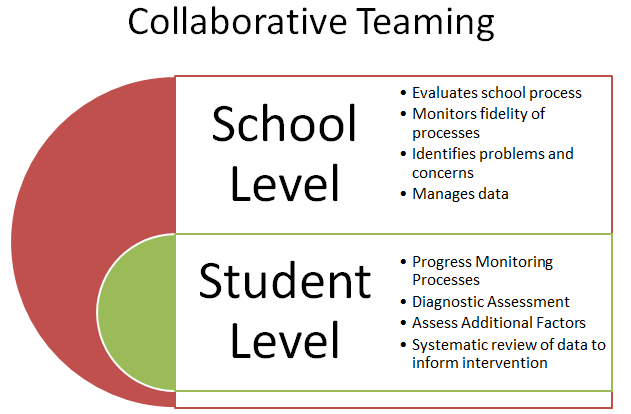
Collaborative teams (grade level, departmental, Tier 2, Tier 3) work interdependently to learn about and communicate the impact of instruction using evidence of student progress to improve outcomes for all students. Collaboration occurs within a framework that increases focus through a standard agenda and problem-solving process, analyzes data, and
Why it’s Essential
A cohesive approach to student achievement requires a collaborative approach where teachers use assessments to inform individual and collective practice. Collaborative teams (grade level, departmental, Tier 2, Tier 3) explore data for patterns and determine the causes for success and performance gaps. These teams put data at the center to guide instruction, adaptations, and interventions, to identify students or groups of students who need additional support, and to monitor student progress. Successful collaboration results in data-informed instruction, data-focused school level and student goals, and data-centered professional development.
Implementation
Core features of collaborative teams are:
- Team members take ownership and accept accountability for the outcomes of all students
- Team members have easy, efficient access to data that is graphically displayed and can be viewed, aggregated and disaggregated for analysis.
- Teams collaboratively develop common purposes and goals for improved student outcomes within a culture that embraces data-based decision making for continuous school improvement.
- Teams effectively utilize team processes (agendas, minutes, dialogue and discussion, norms, logistics, consensus, roles, standard problem-solving process, protocols).
For more detailed information on Collaborative Teams, review the Montana MTSS Essential Components.
Resources
Overview
The multi-tiered approach provides a responsive framework that helps to match academic, social-emotional, and behavioral instruction, intervention, and supports of all students. The tiers are intended to be layered with increasingly intensive supports matched to learner needs. MTSS is not a specific “model” but a framework of effective practices, interventions, and system change strategies that have empirical support and individually have been demonstrated to be effective.
An important component of the tiered framework is the quality of Tier 1 (i.e., the core curriculum), where all students receive high-quality instruction that is culturally and linguistically responsive and aligned to Montana state achievement standards. In a well-designed MTSS system, Tier 1 instruction should be effective and sufficient for about 80% of the student population. When screening indicates a student needs additional support to be successful, evidence-based interventions of moderate intensity are provided. These Tier 2 interventions, which are in addition to the core instruction, typically involve small-group instruction and intervention to address specific identified problems. Students who respond adequately to Tier 2 support return to Tier 1 (the core curriculum) with ongoing progress monitoring. Students who show minimal response to Tier 2 instruction receive additional Tier 3 support, which is more intensive and individualized.
- Tier 1 is the research-based instruction and classroom interventions that are available to all learners and effectively meet the needs of most.
- Tier 2 are evidence-based supplemental, targeted interventions intended for some learners who require support beyond Tier 1.
- Tier 3 supports provide intense individual interventions for a few learners with highly accelerated, or severe and persistent academic and/or non-academic needs.
Why it’s Essential
The framework of a multi-tiered approach provides for efficient and effective allocation of resources. When appropriately used, the tiers support each learner to experience success by meeting their unique needs. Salient to this preventative approach are universal screening, a high quality core instruction, progress monitoring, increasingly intensive tiers of intervention, and fidelity of implementation.
Implementation
Core practices that characterize effective implementation of tiered delivery of supports include:
- High-quality core instruction is in place that meets the academic, social-emotional, and behavioral needs of most students (80%).
- Guidance is provided to faculty and staff to ensure effective use of modeling, practice opportunities, feedback, re-teaching, assessment, intervention, cultural and linguistic responsiveness as part of instruction.
- Well defined systems are in place to facilitate systematic assessment, data-informed decision-making, progress monitoring, and fidelity of implementation.
- A continuum of interventions is available that include criteria for matching the student to the right evidence-based intervention, quick access, intervention protocols, progress monitoring, and monitoring for fidelity of implementation.
- Communication systems are in place for all stakeholders (educators, students, families, community, etc.) regarding the current status and student progress.
- High-quality professional learning opportunities are provided to enhance the use of differentiation and effective classroom practices, and to guide instruction and learning across the tiers.
For more detailed information on Tiered Delivery Systems, review the Montana MTSS Essential Components.
Resources
Overview
A comprehensive screening and assessment system draws on multiple valid and reliable assessments and measures designed to inform instructional and programmatic decisions. Screening includes activities to identify learners who are not mastering grade-level standards and expectation, while further assessment is used to identify students’ strengths and weaknesses in order to determine appropriate intervention or support. Comprehensive screening and assessment includes:
- Balanced assessment system (formative, benchmark/interim, summative)
- Universal Screening measures and decision rules for using data
- Progress Monitoring assessments and decision rules for using data
- Diagnostic assessment process for the identification of specific need and administration of the assessments
Why it’s Essential
A comprehensive screening and assessment system contributes to an outcomes-driven approach that includes meaningful evaluation and commitment to continuous improvement. The data are used to guide determine which practices, interventions, and system change strategies are needed to improve student achievement. When districts and schools work within an MTSS framework, student assessments are a critical component of the entire system. The assessments are used to identify successes and gaps within a system and contribute to program evaluation. Data allows schools to evaluate the overall impact of student supports and can assist in decision-making and inform instruction at the student, classroom, school and district level. A comprehensive system also provides valid data that can be communicated to students, teachers, parents, administrators, and the community.
Implementation
Core features of a comprehensive screening and assessment system include:
- Reliable and valid screening tools used with all students at least three times a year with the first occurring within the first four months of school
- An assessment calendar that includes the following:
- Three universal screening windows per year that includes all students for reading, math and social-emotional/behavior
- Progress monitoring windows
- Diagnostic assessment windows
- Regular monitoring for fidelity of administration and data entry
- Documented time for regular and systematic use of data from the screeners and assessment
- School personnel use reliable and valid screening tools to identify students with at-risk social behavior.
- Universal Screening uses tools that:
- Address several areas of the whole child (e.g. academic, social-emotional, behavior)
- Are quick, efficient, valid, reliable and predictive of future learner outcomes
- Are appropriate for the learners in the setting
- Are monitored for the fidelity of administration and data entry (as applicable)
- Are designed for the purpose of screening rather than assessment.
- Are administered 3x annually
- Progress monitoring tools are used that:
- Address several areas of the whole child (e.g. academic, social-emotional, behavior)
- Are valid and reliable
- Are monitored for fidelity of administration and data entry
- Produce data that are used systematically to evaluate the quality, equity, and efficiency of instruction, interventions and support to create a responsive system that enhances individual learner outcomes
- Are designed for the intended purpose of progress monitoring
- Diagnostic assessments are used that:
- Address several areas of the whole child (e.g. academic, social-emotional, behavior)
- Are valid and reliable, normed for the population and are age appropriate
- Include a process for the identification of specific need and administration of the assessments
- Are monitored for fidelity of administration and data entry
- Produce data that are used systematically to evaluate the quality, equity, and efficiency of instruction, interventions, and supports to create a responsive system that enhances individual learner outcomes
For more detailed information on Comprehensive Screening and Assessment, review the Montana MTSS Essential Components.
Resources
Overview
Data are used to analyze, evaluate and plan strategies that support sustainable system improvement and learner outcomes. This includes conducting needs assessments, efficient data collection practices for multiple data sets (e.g. demographic, student achievement, satisfaction, process data), and a formal process to guide decisions. Data-based decision making (DBDM) requires that data are timely, valid, reliable, accurate and reviewed in ongoing cycles. The roles and responsibilities for data-based decision making within the system are clearly defined and executed.
Why It’s Essential
Using a DBDM process shifts the work of school leadership teams from a reactive or crisis driven process to a pro-active, outcomes driven process, and sets the stage for continuous improvement. Data analysis allows for evidence to guide decision making for both the effectiveness of the system and for the needs of all learners. Examination of data using a standard problem-solving process to review all of the aggregated and disaggregated data for a district, school, groups of students or individual students provides information to narrow the problem to identify potential interventions and strategies.
Implementation
Core practices that characterize effective and continuous DBDM include:
- The Leadership Team has access to and uses multiple sources that are used for DBDM and determine impact:
- Aggregated and disaggregated academic and behavior outcome data
- Input data (e.g., demographic)
- Process data (e.g., quality of instruction, programmatic)
- Outcome data (e.g., learner test scores, dropout rates, office discipline referrals)
- Perception data (e.g., surveys)
- Fidelity data
- At a system level, data are analyzed at least three times each year to
- Set and monitor progress on action plan and school improvement goals
- Map, align, and reallocate resources (fiscal, personnel, time, facilities)
- Determine needs and progress of all learners across all tiers of support
- Evaluate the effectiveness of practices across all tiers all tiers of
- At a student level, data are used to
- Assess, adapt and improve academic and behavior support practices
- Determine which students need additional support
- Identify decision rules (e.g. benchmark cut points, ODRs) to determine which students receive additional Tier 2 or Tier 3 support or intervention
- Progress monitor student rate of growth in Tier 2 and Tier 3
- Increase intensity of intervention based on inadequate rate of growth
- Faculty and staff receive professional learning opportunities and ongoing coaching in the effective use of data
For more detailed information on Continuous Data-Based Decision Making, review the Montana MTSS Essential Components.
Resources
MTSS Resource Library
*NEW* MTSS Overview Video This is a short overview of Multi-Tiered System of Supports for Montana schools. The professional learning video can be used to review MTSS, as a overview for all staff at the beginning of each school year, or as a resource for new staff.
MTSS District Implementation Team (DIT) Modules
*NEW* MTSS Overview Video This is a short overview of Multi-Tiered System of Supports for Montana schools. The professional learning video can be used to review MTSS, as a overview for all staff at the beginning of each school year, or as a resource for new staff.
MTSS District Implementation Team Modules Site
MTSS District Implementation Team (DIT) Pacing Guide
- MTSS DIT Module 1: MTSS Overview, DIT Recruitment, Selection, and Support
- MTSS DIT Module 2: School Readiness
- MTSS DIT Module 3: Building Implementation Team Formation
- MTSS DIT Module 4: District Coaching System
- MTSS DIT Module 5: District Communication Plan and Process for Removing Barriers
- MTSS DIT Module 6: Comprehensive Assessment System
- MTSS DIT Module 7: Data Analysis and Systems Level Problem Solving
- MTSS DIT Module 8: Initiative Inventory and Alignment Process
- MTSS DIT Module 9: District Infrastructure to Support Interventions
- MTSS DIT Module 10: District Initiative and Innovation Review Process
MTSS Building Implementation Team (BIT) Modules
*NEW* MTSS Overview Video This is a short overview of Multi-Tiered System of Supports for Montana schools. The professional learning video can be used to review MTSS, as a overview for all staff at the beginning of each school year, or as a resource for new staff.
MTSS Building Implementation Teams Modules Site
MTSS Building Implementation Team (BIT) Pacing Guide
- MTSS BIT Module 1: Overview of MTSS & Essential Components
- MTSS BIT Module 2: Effective Teams
- MTSS BIT Module 3: Tier 1 Core Curriculum
- MTSS BIT Module 4: Measuring Implementation of MTSS
- MTSS BIT Module 5: Comprehensive Assessment System
- MTSS BIT Module 6: Systematic Problem Solving
- MTSS BIT Module 7: Data Teaming and Pathways for Academics
- MTSS BIT Module 8: Data Teaming and Pathways for Behavior
- MTSS BIT Module 9: Tier 2 Systems
- MTSS BIT Module 10: Tier 3 Systems
- MTSS BIT Module 11: MTSS/RTI Approach to Evaluating Specific Learning Disabilities
OPI Staff are here to help:
Tammy Lysons, Special Education Administrative Coordinator, (406) 431-2309
Anne Carpenter, Program Support Specialist, (406) 465-0922