EDUCATE (Infinite Campus)
Welcome to EDUCATE: The MT Education Data Collection Team
Infinite Campus is the OPI's state-wide school data information system. This system allows school districts to submit required staff, student, and course information electronically. Infinite Campus provides the OPI, the State of Montana, federal entities, and the education community, with timely and accurate data used for state and federal reporting. The MT Education Data Collection Team is teaming up with you to meet all of your data reporting requirements!
Data Collection Calendar
Fall Infinite Campus Collections
Graduate, Dropout, Cohort: October 1 – October 30, 2026
All public-school districts, accredited non-public districts, state funded schools and treatment centers districts must certify their graduate, dropout, and cohort certifications by October 30, 2026 – even if their counts for any of these three components are zero.
Future Ready Certification: October 1 – October 30, 2026
All public high school districts must certify this collection. Data is reported for graduating seniors in 25-26 and includes data from their entire high school career.
Fall Student Count for ANB: October 6 – October 23, 2026
All public-school districts must certify their Fall ANB. This includes Aggregate Hours and Attendance as of October 5, 2026, and indication of participation in programs, including MT Youth Challenge, MT Job Corps, Classroom-Based Early Targeted Intervention, Indian Language Immersion, and SPED ANB Eligibility. Districts must also verify identification of students as American Indian for the American Indian Student Achievement Gap payment.
Fall Enrollment & Program Participation: October 6 – October 30, 2026
All public-school districts, accredited non-public districts, state funded schools and treatment centers districts must certify this collection. The Fall Enrollment Collection is used for Federal Membership reporting and includes only P: Primary enrollments, in grades PK-12, as of October 5, 2026. Students must be reported by gender and race/ethnicity. The Fall Program Participation Collection is required for state and federal reporting. Districts must report participation for all students in the following areas: Free/Reduced meal status (FRAM), Homeless, English Language Learners (EL), 21st Century, Gifted & Talented, Title I (only Targeted Title I schools), Delinquent or At-Risk Students, District Residency, and Foreign Exchange students.
Fall Personnel and Fall Teacher Class will be open for certification on November 2nd.
District Contact Information
Do you need to update your district contact information? Email opiaimhelp@mt.gov
Please copy and paste this information into your email:
- District Name:
- Contact Name:
- Contact Phone:
- Contact Email:
- Contact Type (District Level/School Level):
- Subject Area (General Ed/Special Ed/Both):
- Contact Priority (Primary/Backup):
Missing Child Photo Repository
 We want to remind you to upload student directory photos to the OPI for inclusion in the missing child photo repository. The repository provides law enforcement with immediate, 24/7, year-round access to a child’s school photo should a child be reported missing.
Please review our Student Photo Repository User Guide for detailed instructions on how to complete this process.
District Resources
The district's Primary Contact is the liaison between the district and the state. The Primary Contact is the main contact for data collection issues/questions. Districts are responsible for designating their Primary Contact. To add or change contact information, please follow the process described below:
Do you need to update your district contact information? Email opiaimhelp@mt.gov
Please copy and paste this information into your email:
- District Name:
- Contact Name:
- Contact Phone:
- Contact Email:
- Contact Type (District Level/School Level):
- Subject Area (General Ed/Special Ed/Both):
- Contact Priority (Primary/Backup):
Data certification
Early targeted interventions
- Early Targeted Interventions Classroom-Based Guide (PDF)
- Early Targeted Interventions Home-Based Guide (PDF)
- Early Targeted Interventions Jumpstart Guide (PDF)
Out-of-district attendance
Graduates and dropouts
Calendars
Teacher class
Average Number Belonging (ANB)
Enrollments and program participation
Staff reporting
Behavior
Users
Future Ready Information
- DLI Montana Credential Registry 2025-26
- Postsecondary Credits Counted Toward the Future Ready Payment
- 2027 Course Codes (PDF, opens in a new tab)
- 2027 Work-Based Learning Course Codes (PDF, opens in a new tab)
- 2027 Financial Literacy Course Codes (PDF, opens in a new tab)
- 2027 Special Education Specific Course Codes (PDF, opens in a new tab)
- 2026 Montana Digital Academy Course Information (PDF, opens in a new tab)
- 2026 Course Codes (PDF, opens in a new tab)
All imports, except the Student Demographic import, require Student State ID numbers. Complete the Student Demographic upload first, followed by the Student Enrollment upload. After those two uploads are complete for every student, all other uploads may be submitted. To ensure you are using the most current version, download templates from this page as needed.
STUDENT templates
- Student Demographic Template (Excel)
- Student Enrollment Template (Excel)
- Program Participation Template (Excel)
- Section 504 Template (Excel)
- English Learners (EL) Template (Excel)
- Fall Enrollment Count Template (Excel)
- Fall Career and Technical Education (CTE) Template (Excel)
- Spring Enrollment Count Template (Excel)
- End of Year Attendance Totals Template (Excel)
- End of Year Career and Technical Education (CTE) Template (Excel)
Course Templates
- Course Template
- Course Section Template
- Course Staff Template
- Course Roster Template
- Course Section Student Detail Template
Staff Templates
Please note: Infinite Campus systems are unavailable during updates. Updates are typically applied after 5:00 p.m. on Friday and systems are restored and available the following Saturday morning. Target dates are subject to change.
Release schedule is subject to change.
| Campus release version | Date available in Montana |
|---|---|
| 2619 | May 22, 2026 |
| 2615 | April 24, 2026 |
| 2607/2611 | March 20, 2026 |
| 2603.13 | February 20, 2026 |
| 2551.4 | January 16, 2026 |
| 2543, 2547 | December 5, 2025 |
| 2535.1 Rx Pack | September 17, 2025 |
| 2531, 2535 | September 5, 2025 |
| 2527 | August 1, 2025 |
| 2519, 2523 | July 11, 2025 |
| 2515 | May 23, 2025 |
| 2511.9 Rx Pack | Emergency patch March 27, 2025 |
| 2511 | March 21, 2025 |
| 2451, 2503, 2507 | March 7, 2025 |
| 2447 | December 13, 2024 |
| 2439, 2443 | November 15, 2024 |
| 2435.14 Rx Packs | September 13, 2024 |
| 2431, 2435 | August 30, 2024 |
| 2427.15 Rx Packs | August 7, 2024 |
| 2423, 2427 | July 19, 2024 |
| 2415, 2419 | May 18, 2024 |
| 2407, 2411 | March 23, 2024 |
| 2351, 2403 | February 16, 2024 |
| 2343, 2347 | December 15, 2023 |
| 2335, 2339 | October 20, 2023 |
| 2327, 2331 | August 25, 2023 |
Information on Infinite Campus releases
- Infinite Campus Release Notes (opens in a new tab) – Details about version updates and changes.
Infinite Campus technical references
Infinite Campus Community support resources:
NOTICE: Please do not email any student personally identifiable information (PII), including names or student IDs, to the OPI or the AIM Help Desk. Call AIM Support directly for assistance with individual student PII, or use ePass Montana for the secure transfer of larger student data files.
Campus Playbook: Beginning of the year series
- Session 1: Kickoff and Calendar Setup Slides Recording - Password CampusRecording8.21.2026
- Session 2: Building the Roser Slides - Recording - Password CampusPlaybook8.28.2026
- Session 3: Staffing the Sidelines Slides - Recording - Password CampusPlaybook9.4.2026
- Session 4: Checking the Scoreboard Slides - Recording - Password CampusPlaybook9.11.2026
- Session 5: Finishing the Play Slides No Recording
The AIM Data Dictionary is intended to assist local education agency (LEA) staff and their student information system vendors in understanding the specific data elements and codes that must be populated for state reporting through AIM. It supports accurate and consistent data collection by maintaining standardized data element definitions that meet state and federal reporting guidelines.
AIM Data Dictionary (PDF)
Updated April 2024
The purpose of this page is to provide general information about the OPI AIM student information system, along with its purpose and processes.
Questions can be directed to the OPI AIM Help Desk at 877-424-6881 or by submitting an AIM Help Desk ticket .
The Montana state student information system
The AIM system is designed to collect demographic, enrollment, program participation, and assessment data for each student. The program also tracks special education students’ IEP data and all students’ movement from school to school and district to district within Montana. It allows for timely reporting and data accuracy through standardized reporting capabilities, and it enables school districts to submit the required student information electronically.
The AIM system provides the OPI, the State of Montana, federal entities, and the education community with timely and accurate data about the progress of our students, schools, school districts, and the state.
Please see the AIM Policy References webpage for pertinent state and federal laws that apply to AIM.
Infinite Campus: the company and software
The Montana Office of Public Instruction (OPI) adopted the Infinite Campus software application as its statewide student information system (SIS). The OPI calls the state-level SIS “Achievement in Montana” (AIM). The name of the company that owns the Infinite Campus software is also Infinite Campus.
State Edition. The State Edition of Infinite Campus is used by OPI staff and contains the state-reported student data from all Montana districts.
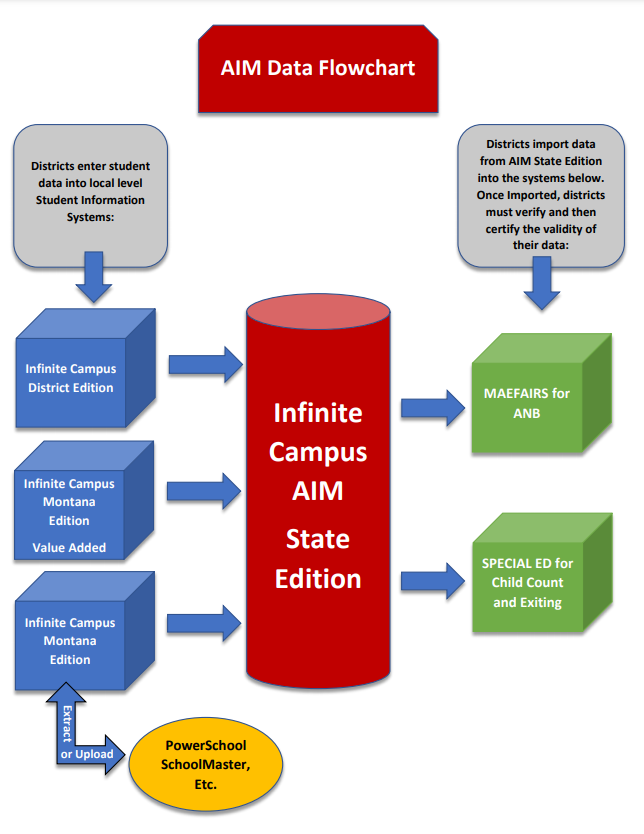
Montana Edition. The Montana Edition of Infinite Campus is provided to districts at no cost so that schools that do not use Infinite Campus as their local SIS can submit their data into the statewide Infinite Campus system for state reporting.
Montana Edition – Value Added. The Montana Edition – Value Added is typically used by small districts as their main local student information system. Districts use it to maintain enrollment, demographic, program participation, and special education IEP data. The value-added features also allow districts to maintain students’ daily attendance and marks data.
District Edition. The District Edition of Infinite Campus is used by some districts as their complete local SIS.
Movement of AIM data
Data originates at the district level and is copied to the state level of Infinite Campus by a syncing process. This syncing happens automatically when data is entered and saved in Infinite Campus or when a district runs a mass syncing process to copy data to the state level.
When local district data is housed in a different local SIS (other than Infinite Campus), larger districts typically use a mass export and upload process to move data into the Montana Edition of AIM. Smaller districts may choose to enter their data directly into the Montana Edition. That data then goes through a nightly syncing process to be copied into the State Edition of AIM.
Once the data is at the state level, it is ready to be reviewed and validated by OPI staff for reporting purposes. OPI uses state-level data snapshot processes for some federal reporting that affects district funding. Districts use import processes to copy their state-level data into other OPI subsystems that also affect school funding (such as MAEFAIRS and Special Education). Other systems, such as the Child Nutrition Program (CNP) for free and reduced-price lunch funding, also pull data from the State Edition of AIM.
AIM data security policies
Please refer to the OPI Student Privacy webpage (opens in a new tab) for OPI data security policies.
AIM relevant state laws and rules
Administrative Rules of Montana (ARM)
| ARM citation | Topic |
|---|---|
| ARM 10 | Education |
| ARM 10.55 | Curriculum and assessment |
| ARM 10.56 | Statewide assessment |
| ARM 10.63 | Early childhood education |
| ARM 10.15.101 | School funding definitions (see especially “average daily attendance” (ADA)) |
| ARM 10.20.102 | Calculation of Average Number Belonging (ANB) |
| ARM 10.21.204 | American Indian Achievement Gap Payment |
| ARM 10.55.904 | Basic education program offerings: high school |
| ARM 10.55.906 | High school credit |
| ARM 10.55.909 | School records |
Montana Code Annotated (MCA)
| MCA citation | Topic |
|---|---|
| MCA Title 20 | Education |
| MCA 20-1-212 | Destruction of records by school districts |
| MCA 20-1-213 | Transfer of school records |
| MCA 20-1-230 | Interstate Compact on Educational Opportunity for Military Children |
| MCA 20-1-301 | School fiscal year aggregate hours |
| MCA 20-5-101 | Admittance of child to school |
| MCA 20-7-104 | Transparency and public availability of public school performance data |
| MCA 20-7-117 | Kindergarten and preschool programs |
| MCA 20-9-309 | Basic system of free quality public elementary and secondary schools defined |
| MCA 20-9-311 | Calculation of Average Number Belonging (ANB) – 3-year averaging |
| MCA 20-7-1317 | Electronic directory photograph repository |
U.S. Department of Education
- Federal reporting file specifications (EDFacts, 2020–21) (opens in a new tab)
- Every Student Succeeds Act (ESSA) high school graduation rate guidance (PDF, opens in a new tab)
- Montana state plan for the American Rescue Plan Elementary and Secondary School Emergency Relief (ESSER) Fund (PDF, opens in a new tab)
U.S. Department of Education race and ethnicity policy
Federal Q&A resources
The U.S. Department of Education has finalized changes to the collection and reporting of race and ethnicity. Beginning with the 2010–2011 school year, all students must be identified using a new two-part race and ethnicity question, which recognizes Hispanic ethnicity and race as separate concepts and supports reporting of multiple races.
- Dear Colleague letter from the Office of Planning, Evaluation, and Policy Development (OPEPD) (opens in a new tab)
- U.S. Department of Education race and ethnicity policy questions and answers (opens in a new tab)
- Office of Planning, Evaluation, and Policy Development (opens in a new tab)
- Race and ethnicity guidance for the collection of federal education data (opens in a new tab)
District information
The OPI has developed guidance and resource materials for districts as they implement the new federal race and ethnicity standards.
- Race and Ethnicity Guidance to Schools (PDF, opens in a new tab)
- Race and Ethnicity Reporting Form – Detailed (PDF, opens in a new tab)
- Race and Ethnicity Reporting Form – Short (PDF, opens in a new tab)
- Suggestions for Conducting Observer Identification (PDF, opens in a new tab)
Parent information
Additional resources
- NCES Forum Guide to Implementing New Federal Race and Ethnicity Categories (PDF, opens in a new tab)
Military Interstate Compact Commission
External resources
- School Services of Montana (SSoM) – Infinite Campus support (opens in a new tab)
- National Forum Guide to Collecting and Using Attendance Data (February 2018, PDF; opens in a new tab)
- National Forum Guide to Data Visualization (October 2016, PDF; opens in a new tab)
- National Forum video on School Courses for the Exchange of Data (SCED) (July 2016, opens in a new tab)
Internal OPI resources
- Student Photograph Repository Project (opens in a new tab)
- GEMS (Growth and Enhancement of Montana Students) website (opens in a new tab)
- MAEFAIRS login (opens in a new tab)
- School Finance website (opens in a new tab)
Montana Early Warning System (EWS)
The Montana Early Warning System (EWS) model uses readily available school, student, and other live data to identify students who are at risk of dropping out of school before they leave. Students are identified early so that school staff can intervene and help keep them in school.
The Montana EWS is a logistic regression model that uses data such as attendance, behavior, grades, mobility, and other factors to determine whether a student is at risk. The model identifies students in grades 6–12 who may be at risk and provides indicators for the reasons each student is identified.
Watch Montana’s Early Warning System (EWS) introduction recording (YouTube, opens in a new tab)
Because the Montana EWS uses live data, it can be run at any time during the school year or summer. This allows educators to see how a student is progressing or regressing over time and to track whether interventions are working.
School-level reports are also available in the Montana EWS so educators can track their school-wide EWS results over time and compare them to statewide averages.
EWS User Guide – Montana Early Warning System: Required Data Setup (documentation in Infinite Campus Community; opens in a new tab) This documentation is intended for districts using the District Edition of Infinite Campus as their primary student information system. See the “Required Data Setup” section at the top of the page for details.
If you have questions about the Montana EWS, please contact: Kaitlyn Greenhalgh, K–20 Data and Research Analyst, Office of Public Instruction, Kaitlyn.Greenhalgh@mt.gov, 406-444-1610.
OPI Staff Are Here to Help
Shara Blair - Education Data Support & CTE Data Collections, 406-444-0685
Jennifer Straw - Education Data Support, 406-444-0714
Ashley Koepke - Education Data Support, 406-444-0375
Nicole Thuotte - Education Data Team Unit Manager, 406-444-2080
Submit a Help Desk Ticket, call 1-877-424-6681 or 406-444-3800, or email opiaimhelp@mt.gov.