Career, Technical, and Adult Education (CTAE)

Announcements

Perkins and State CTE Funding for FY 2027

Carl Perkins Grant Fiscal Year 2026 (Current grant cycle)

  • 25th of Each Month- Deadline to submit cash requests for processing and payment on the 10th of each month
  • June 10th- deadline for the last June payment. If your district has not completed a Cash Request, it MUST be in by this date.
  • Last day to obligate funds: June 30th
  • Last day to create amendments: June 30th 
  • Last Date to liquidate funds: July 25th 
  • August 25th- Perkins 2026 Final Expenditure Reports are due.  If you are late submitting your FER- it will result in keeping the entire state from receiving final allocations

Carl Perkins Fiscal Year 2027 (Next school year grant)

This will be a CLNA year, districts will need to complete the CLNA worksheet, Summary Questions and meet the eligibility requirements: Submitted 2025 End of Year CTE Data, Fall 2025 CTE Data Report, and have approved Montana Career Pathways (Class AA/A- 3 pathways, Class B- 2 pathways, Class C- 1 pathway).


Class 4 Renewal Requirements 

Teacher Endorsement Codes & K-12 Course Codes

Class 4 Educator License Options

Class 4A, 4B, or 4C Work-Based Learning Endorsement

A Work-Based Learning (WBL) Coordinator plays a crucial role in connecting students' classroom education with real-world work experiences. They serve as a bridge between educational institutions, students, and employers, facilitating meaningful learning opportunities that prepare students for future careers and post-secondary education. A WBL endorsement is a specialized credential that allows an educator OR a Qualified Workforce applicant to lead and manage work-based learning programs within a school or district. 

For More Specific Information Visit the License Option Page

Montana Financial Literacy & Econ Graduation Requirement Fact Sheet

Curriculum Resources

Financial Literacy Standards Crosswalk

Financial Literacy Course Codes

  • Montana financial literacy and economics courses are a subset of NCES (National Center for Education Statistics) standard codes. Along with the course code, a content description for each course is provided where financial literacy or economics is embedded within the course:
  • Professional Development Optional Opportunities 

Next Gen Personal Finance Certification

Montana CTE Technical Assistance

We have scheduled several dates to provide focused technical assistance for transitioning to the new Montana Career Pathways, CTE Date and Perkins Applications Support. The following dates and times will be available for districts to get targeted CTE support, from 10 am - 2:00 pm. As always if you need additional support please reach out to anyone on our team and we can set up another time.

  • Wednesday, June 24th
  • Tuesday, June 30th - Perkins Apps Due
  • Technical Assistance Available throughout July & August

Topic: CTAE Technical Assistance

Career Technical Education logoJoin Zoom Meeting

https://zoom.us/j/91271668254?pwd=4ryRN6Gj5oiOv34k10Pw224HsZBDki.1

Meeting ID: 912 7166 8254

Passcode: 046242

Career Technical Education Resources

Agricultural Education is a sequential set of course offerings for students in grades 7-12. The program is designed to develop knowledge, skills, attitudes, and experiences in and about agriculture. Ag Ed prepares students for further education, self-employment, entry-level jobs, and consumer awareness in the agriculture industry. Vocational Agriculture, as it was formerly called, was started in Montana in 1917 with the passing of the federal Smith-Hughes Vocational Act. Curriculums in Ag Ed may contain: Ag Business, Animal Science, Aquaculture, Forestry, Horticulture, Leadership, Mechanics, Natural Resources, Plant Science, and Wildlife Management. Most programs consist of three major components: classroom and laboratory instruction, supervised agricultural experiences (SAE) and membership in the FFA. Quality programs are conducted on a year-round basis with students actively engaged in educational activities over the summer months.

Montana Agricultural Network (Magnet 2.0)

Resources

Student Group - FFA

FFA logoFFA is a Montana youth organization that makes a positive difference in the lives of students by developing potential for premier leadership, personal growth, and career success through agricultural education.

School Based Agricultural Education

Most schools with an agricultural education program provide hands-on experiences for their students with:

  • Mechanics Laboratories
  • Greenhouses
  • Aquaculture/Aquaponics Labs
  • Land Plots
  • Animal Laboratories

SAEs can consist of:

  • Placement/Internship
  • Entrepreneurship/Ownership
  • Research (Experimental, Analytical, or Invention)
  • School Based Enterprises
  • Service Learning
  • Exploratory in Nature

Prepares students for:

  • Premier Leadership
  • Personal Growth
  • Career Success

There are in excess of 165 Business and Marketing Education programs and 280 teachers in the public high schools of Montana. These programs and teachers are dedicated to the preparation of students for a world-class workforce. Through communication, professional development, and coordination of talent, a determined effort is under way to make Montana a great place for students to meet their career goals and for employers to be confident in the relevance of skills being taught and learned.

A showcase for Business and Marketing Education Programs are our Career and Technical Student Organizations. These organizations are Business Professionals of America and DECA. CTSOs provide students with soft skills (leadership, character, and community service competencies), as well as competitive events that build on sound content and skill development.

Resources

Framework for Business Education in Montana 

Montana’s rapidly growing Career and Technical Education program is Health Science. Health Science courses prepare students for further education and/or immediate employment in health care fields.

The purpose of Health Science programs in high school is to teach essential knowledge and skills needed by health care providers based on theNational Health Science Standards that address:

  • Academics & Employability Skills
  • Communications & Teamwork
  • Healthcare Delivery Systems
  • Legal Responsibilities & Ethics
  • Safety & Health Maintenance Practices
  • Technical & Information Technology Skills

Montana Health Science Education Website

Career Pathways in Health Science

Exploring a Health science pathway in secondary education allows students to concentrate their efforts in foundational skills that are applicable to all health science areas.  Students in high school health science programs receive a solid foundation to matriculate into therapeutics, diagnostics, health information, biotechnology or support services at the collegiate level as they focus on a career path in healthcare.

  • Health Science Career Pathways
  • Montana Career Pathways - Health Professions 

  • MCP changes the way career pathways are developed, displayed, documented, and implemented.
  • It improves how students, parents, and educators get information about in-demand career options in Montana and provides actionable information for students to explore and engage in careers while in high school.
  • MCP is supported in part by Perkins fundsPerkins Reserve Grants (formerly Strengthening Montana Career Pathways Grants) build collaboration between secondary and postsecondary educators across the state to expand access to dual enrollment, work-based learning, and industry recognized credentials that support a career pathway.

Montana HOSA

HOSA logoMontana HOSA: Future Health Professionals provides a unique program of leadership development, motivation, and recognition exclusively for secondary and collegiate students enrolled in health science education and biomedical science programs or have interests in pursuing careers in health professions.

Providing Transformative Learning Experiences

PLTW logoProject Lead The Way provides transformative learning experiences for PreK-12 students and teachers across the U.S. We create an engaging, hands-on classroom environment and empower students to develop in-demand knowledge and skills they need to thrive. We also provide teachers with the training, resources, and support they need to engage students in real-world learning.

Industrial Technology Education Montana logoIndustrial Technology Education, where innovation meets application and hands-on learning drives real-world problem-solving. Our dynamic programs provides a comprehensive exploration of the technologies and industrial processes essential for a thriving economy, equipping students with invaluable practical skills and a deep understanding of how technology shapes our daily lives.

Students in Industrial Technology Education programs are exceptionally positioned to step into thousands of high-demand, high-wage careers, becoming the next generation of leaders in a rapidly advancing technological landscape. These essential roles include a wide array of skilled trades, from precision machining and electrical systems to innovative construction and fabrication, all of which are fundamental to industry growth and offer robust pathways to success for Montana students.

Montana Industrial Technology Education Teacher Website

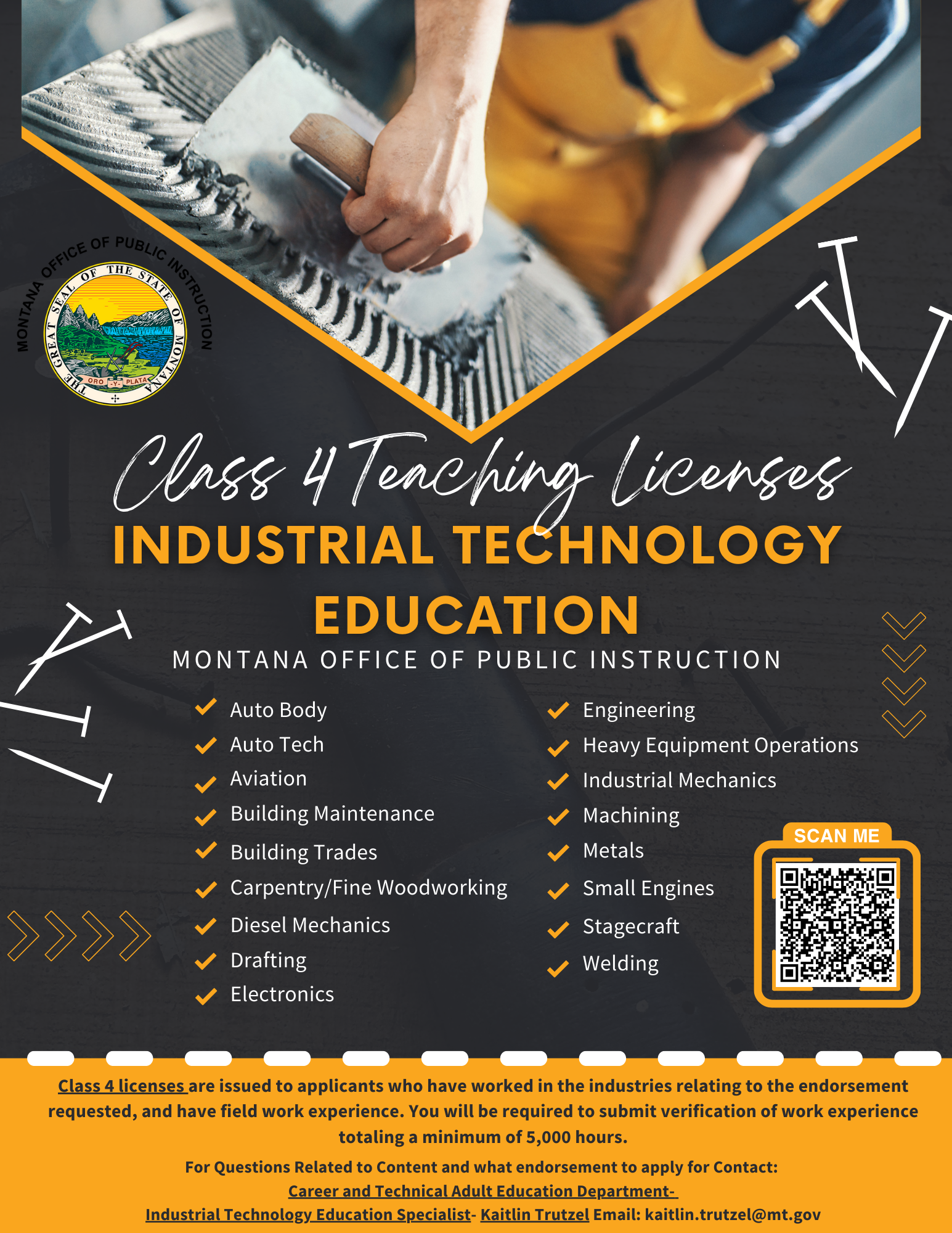
Class 4 Teaching Licenses graphic
Requirements For Montana Class 4 Educator Licensure

A Class 4 Educator License, are designed for individuals who wish to teach Career and Technical Education subjects, including Industrial Technology, in public schools. Unlike traditional teaching licenses that often require a bachelor's degree in education and a teacher preparation program, the Class 4 license leverages an applicant's extensive real-world experience and industry expertise. This alternative pathway gives applicants the opportunity to teach based on practical knowledge and skills, typically gained through significant work hours to effectively instruct students in specialized vocational and technical fields. This pathway ensures that students in Montana's CTE programs can benefit from instructors who bring invaluable, hands-on industry experience directly into the classroom.

License Renewal Requirements For my Class 4 License:

Class 4A licenses: 60 professional development units or any combination of professional development units and semester/quarter college credits. Each semester credit is worth 15 professional development units and a quarter credit is worth 10 professional development units. The first renewal must show evidence of professional development units earned in the following content areas: curriculum and instruction in career and technical education; and safety and teacher liability.

Class 4B or 4C licenses: 60 professional development units or any combination of professional development units and semester/quarter college credits. Each semester credit is worth 15 professional development units and a quarter credit is worth 10 professional development units. The first renewal must show evidence of professional development units earned in the following content areas: curriculum and instruction in career and technical education; and safety and teacher liability.

Other professional development appropriate to renew a Class 4B or 4C license includes the following: principles and/or philosophy of career and technical education; curriculum and instruction in career and technical education; learning styles/teaching styles; including serving students with special needs; safety and teacher liability; classroom management; teaching methods; career guidance in career and technical education; or endorsement related technical studies, with prior OPI approval.

Montana Career Pathways

Montana Career Pathways is a fantastic tool for discovering the hundreds of CTE career opportunities available in Montana. MCP can provide you with the knowledge you need to choose the right path for you. Features include: graduation requirements, volunteer work, internships & apprenticeships, coursework and recommended classes, major options, career options, job growth, average salary and starting salary, industry recognized credentials (IRC's) and so much more. Click the here to get started.

Career Pathways

What is Dual Enrollment - Dual Enrollment Delivery Methods & Credit Options

Dual Enrollment is the broad term for opportunities for high school students to take college courses while still in high school. Students take Dual Enrollment courses for either Dual Credit or College Credit Only. Dual Credit courses award high school and college credit simultaneously for the same course. College Credit Only courses award college credit (and not high school credit) for a college course.

  • Montana University System colleges and universities offer Dual Enrollment courses via two delivery models: Early College and Concurrent Enrollment.
    • Early College courses are standard college classes that are open to high school students and offered on a college campus or online for Dual Credit or College Credit Only.
    • Concurrent Enrollment Courses are college courses taught at a high school to a class of high school students by a qualified high school teacher for Dual Credit.

Learn more about Dual Enrollment opportunities in Montana.

One-Two-Free

One-Two-Free is the Montana University System's Dual Enrollment program. One-Two-Free launched in August 2018 as a pilot program funded by the MUS to increase access to higher education for high school students, reduce education costs for Montana families, and enhance student success. In February 2020, Montana Governor Steve Bullock and Commissioner of Higher Education Clayton Christian announced the continuation of One-Two-Free.

  • The program offers two dual enrollment courses, or up to six credits, through the MUS to all eligible students for FREE. One-Two-Free also allows students who demonstrate hardship to apply for a scholarship to cover tuition for additional Dual Enrollment courses.

Roberta Tilleman, SkillsUSA State Director (406) 868-3489

Montana SkillsUSA

Jesse Gray, TSA State Directors (406) 676-3390 ext. 7553

Montana TSA

Why Family & Consumer Sciences?

Family and Consumer Sciences Education logo

Family & Consumer Sciences (FCS) Education’s vision is to empower youth to manage the challenges of living and working in our society.

Beginning with life literacy education—education to enhance the ability to make informed decisions about their lives—youth then learn how the same knowledge and skills are foundational to people‑centered careers. Many agree this is vitally important to the education of our youth today, as living healthy lives is key to community vitality. People‑ centered careers are also vital to meeting the needs of human beings.

Beginning in the middle grades, Family & Consumer Sciences Education’s mission is to prepare students for family life, work life, and the foundational skill set of high‑skill, high‑need, people‑centered careers through Family & Consumer Sciences pathways (see career examples for each):

  • Design and Construction–FCS (for example, interior design, fashion design/consulting, entrepreneur)
  • Education and Training (for example, pre‑K through post‑secondary educator, school counselor, worksite trainer)
  • Hospitality & Tourism (for example, event planner, tourism director, chef, entrepreneur)
  • Human Services (for example, childcare, social work, family advocate, credit counselor, nutritionist, geriatric program manager)
Learn more about Montana FCS Education

To learn more about Montana FCS Education, visit the Montana FCS Network website .

To learn more about how Montana FCS Education and FCCLA provide “Foundational Life Literacy for Workforce Success” (PDF) , download and review the foundational life literacy overview.

Family, Career and Community Leaders of America (FCCLA)

An intracurricular component of Family & Consumer Sciences (FCS) Education knowledge and skill mastery is Family, Career and Community Leaders of America (FCCLA), where students:

Student benefits

  • Gain leadership experience and personal growth.
  • Develop employability skills including teamwork, communication, speaking, time management, and responsibility.
  • Experience real-world applications of FCS content to enhance mastery.
  • Learn by doing under the guidance of a licensed FCS adviser.

School benefits

  • Receive additional funding support for having an FCCLA chapter.
  • Increase student engagement and support higher graduation rates.
  • Build high-quality career and technical education programs with CTSO experiences.
  • Offer FCCLA as a resume builder for students in all areas, which is especially important in rural schools where other opportunities are limited.

Community benefits

  • Provide strong service-learning projects with economic value to meet community needs.
  • Elevate youth voice, which contributes to a stronger community structure.
  • Help businesses develop a youth employee base with stronger employability skills.
  • Strengthen community–youth connections, which can increase students’ desire to return and raise their families in the communities where they grew up.

For more information, visit the MT FCCLA website .

Be a part of the FCS education family

Be a part of the Family & Consumer Sciences (FCS) education family for the following reasons:

  • Teach topics that you and your students can apply in their daily lives.
  • Select a family-friendly career that understands parents are important in the lives of their children.
  • Benefit from strong job placement opportunities across Montana.
  • Start with competitive entry-level wages and advance as your experience and responsibilities grow.
  • Travel with your FCCLA chapter across the United States.

For more information, see the MSU FCS Education website .

High School District Liaisons for CTE

The CTE Specialists have been assigned regionally to schools. The regions are Eastern, Northcentral, Northwest, Southcentral, and Southwest. These assignments will be used to review the 2025- 2026 Perkins Grant application and any remaining 2024-2025 amendments. If you have any questions or need assistance, our team of specialists is available to support you.

Montana Career and Technical Education

Guidance Documents

Below you can find information related to CTE Funding, Montana Career Pathways, Carl Perkins Grant and Data, State CTE Data, Work Based Learning and related topics. If you would like all of this information in one document you can reference that here. The below documents are broken into three different categories; CTE Funding Guidance, CTE Montana Career Pathways, Montana Work Based Learning.

A graphic with text: Career Technical Education Funding Guidance - Strengthening CTE in your district Graphic with text: CTE Montana Career Pathways Guidance - Strengthening CTE in your district. Graphic with text: CTE Work Based Learning Guidance - Strengthening CTE in your district

Career and Technical Student Organization State Directors